
FileMaker Cloud typically trails slightly behind its on-premise sibling, FileMaker Server, in the upgrade release cycle. The difference comes down to architecture. FileMaker Cloud was designed to eliminate the need for users to manage their own hardware, updates, and security—providing a fully managed, always-available hosting environment. But that same architecture also means some features are limited or delayed to maintain the higher security standards and operational stability required in a shared cloud platform.
That gap recently closed. With the 2025 release, FileMaker Cloud now stands shoulder-to-shoulder with FileMaker Server 2025—offering the same feature set, performance, and security, plus a few Cloud-only advantages.
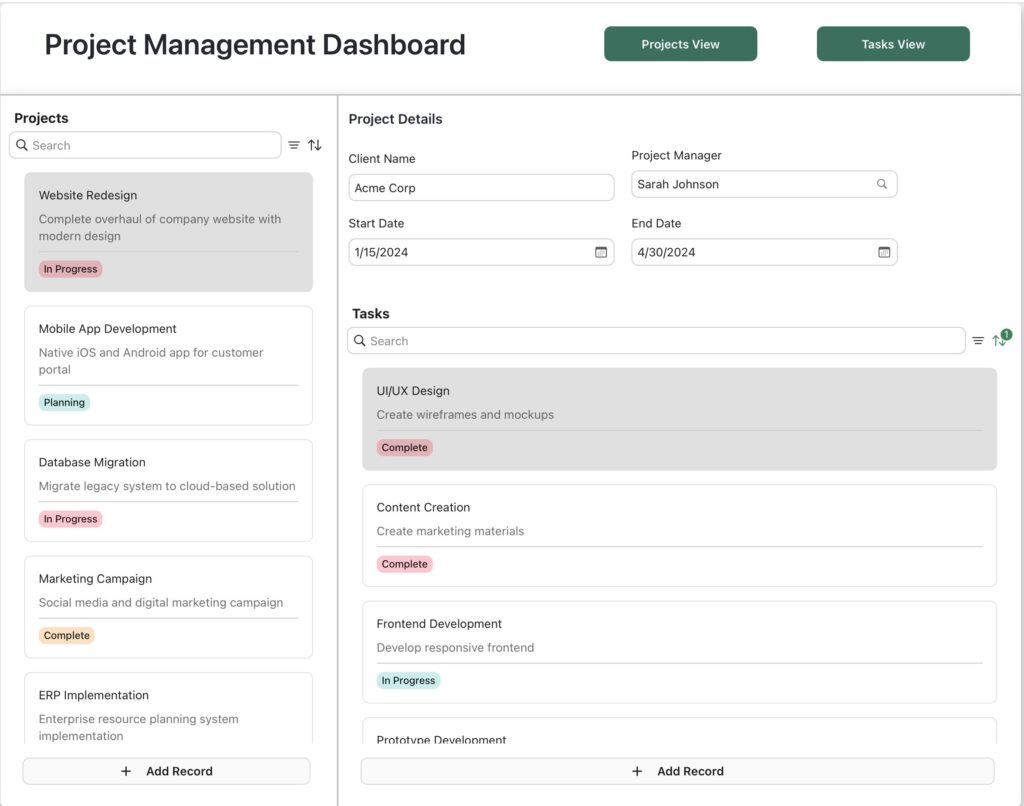
Claris Studio integration: Access FileMaker data through the web
A key addition in this release is integration with Claris Studio, allowing developers to access and display FileMaker data through customizable web views. This connection creates a direct pathway between FileMaker data and browser-based interfaces, enabling secure, real-time data exchange without the need to duplicate or export information.
Claris Studio integration also simplifies external data collection and presentation. Teams can use web forms or dashboards connected to FileMaker datasets, ensuring that input from outside users flows directly into the same system used internally. It’s a streamlined way to extend FileMaker’s reach beyond the desktop and mobile environment while maintaining centralized control over data integrity and permissions.
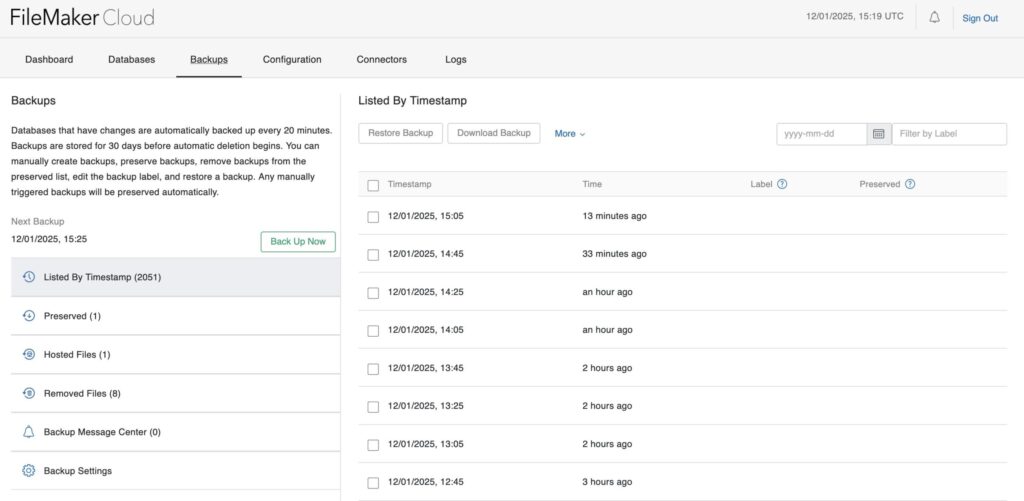
Enhanced admin console and security improvements
The Admin Console in FileMaker Cloud 2025 receives significant updates focused on monitoring, visibility, and data management. Administrators can now track database uploads and downloads in greater detail and apply extended retention policies for removed databases. These improvements strengthen operational transparency and reduce risk during migration or cleanup processes.
FileMaker Cloud now includes stronger protection against denial-of-service (DoS) attacks and improved compatibility handling by automatically blocking older versions of FileMaker Pro and FileMaker Go.
Supported clients and version alignment
With this release, Claris decided to drop support for versions of FileMaker older than 20.x. Then, in 2026, support for version 20.x will also be dropped with the release of 22.0.4. Claris states this step was necessary to ensure version parity and to maintain a consistent, secure ecosystem across both Cloud and Server deployments.
This alignment means developers and administrators can plan upgrades and deployments using a unified versioning model. Whether hosting in the cloud or on-premise, teams will work with the same compatible client set and identical platform capabilities.
Updated OData: Broader integration capabilities
This release also introduces an updated implementation of OData, the open protocol that enables external systems to query and interact with FileMaker data. The update brings a host of features:
- Advanced querying options
- Improved file handling
- Expanded support for MIME types, allowing smoother integration with third-party applications such as reporting tools, web services, and data analysis platforms.
Developers can now work with a wider range of data formats and automation workflows, reducing the need for custom scripting or middleware when integrating FileMaker with external systems. The result is a more consistent and flexible way to connect FileMaker data to modern cloud and enterprise environments.
FileMaker Cloud Pricing
FileMaker Cloud has been a reasonably priced option for those wanting a hands-off, managed server solution. Hosting comes in two flavors: Starter (formerly Essentials) at $22 per user per month and Max (formerly Standard) at $45 per user per month. While the price difference between the tiers is significant, the Max tier offers greater capabilities. The table below illustrates the differences.
| Starter | Max | |
| Hosting limit | 3 apps | 256 apps |
| Storage | 2 GB per user/year (no upgrades) | 6 GB per user/year (upgrades available) |
| API usage | 2 GB outbound data transfer of FileMaker Data API/OData per user per month. | 2 GB outbound data transfer of FileMaker Data API/OData per user per month. |
| Compute | Large (2 CPU, 8 GB). No upgrades available. | Varies based on number of users. Upgrade available. |
| Claris Connect integration | 5 active flows* | 50 active flows* |
| Claris Studio web views | 10 native web views published for consumption | Unlimited native web views published for consumption |
A welcome addition for both tiers is that Claris Studio and Claris Connect are now included with each plan. This is also true for on-premise hosting options.

Cloud and server in sync
FileMaker Cloud 2025 marks a noteworthy point in the platform’s evolution. With full feature parity and aligned versioning, the choice between hosting options now depends less on capability and more on infrastructure preference.
- Organizations that want a fully managed, Claris-operated environment can turn to FileMaker Cloud, which eliminates the need to handle security patches, OS updates, or hardware maintenance.
- Those who prefer to maintain direct control over their infrastructure can continue using FileMaker Server – either with an in-house installation or by working with a managed hosting provider such as Portage Bay..
These options now share the same technical foundation and feature set. Whether hosted in Claris Cloud, on in-house servers, or through a third-party provider, users can choose the best options for their specific needs without compromising on features.
We have clients who fall into each of the three hosting categories, and we are experienced in providing the nuanced support they need. We provide hosting services for many of our clients, who don’t wish to handle the technical details themselves and who don’t want to be responsible for monitoring server maintenance and backups.
Get in touch with us to discuss what options are right for you.
This piece represents a collaboration between the human authors and AI technologies, which assisted in both drafting and refinement. The authors maintain full responsibility for the final content.