
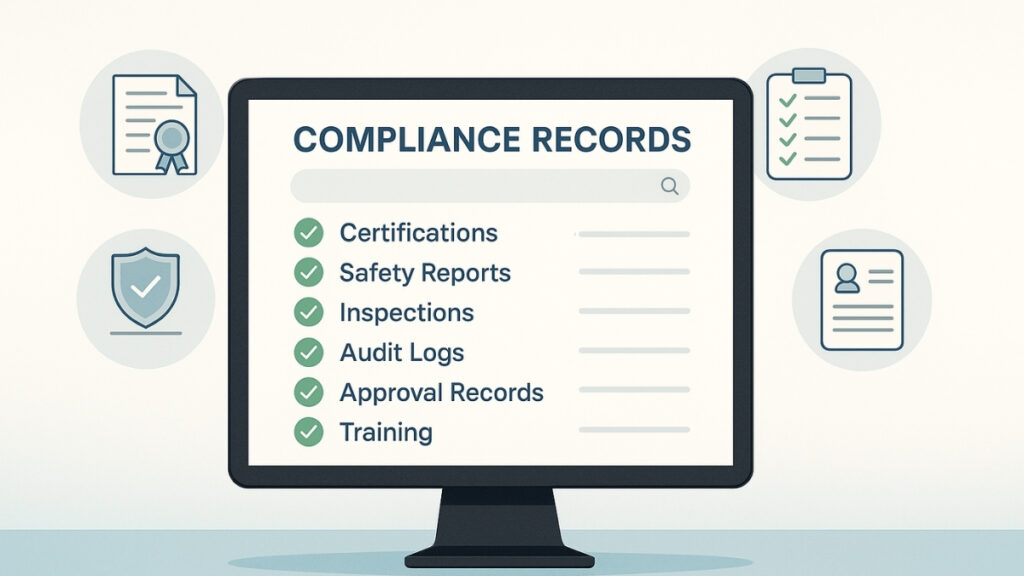
Compliance requirements often emerge from multiple directions: industry standards, state regulations, federal rules, customer demands, or internal policies. As the organization grows, so does the volume of documentation that must be kept for years. When this information lives in different folders, emails, spreadsheets, or department-specific systems, even simple requests can become difficult to fulfill. Centralizing compliance records solves this by creating one reliable location for everything.
Why compliance becomes complicated
Regulatory work isn’t inherently difficult, but it’s the fragmented record keeping that creates most of the burden. Different teams may store information in different ways: safety records in shared drives, certifications in email threads, inspection logs on paper, and policy updates scattered across personal files. None of these choices are wrong in isolation, but together they create uncertainty.
Some common challenges include:
- Not knowing which version of a document is the current one
- Difficulty locating proof of compliance during audits
- Missing or incomplete records due to personal filing methods
- Delays caused by cross-checking multiple sources
- Gaps in documentation when staff transition or leave
- Redundant data entry across several systems
Over time, these issues become a risk—not because the organization is non-compliant, but because the evidence required to prove compliance is difficult to reconstruct.
A realistic scenario
Imagine a healthcare or manufacturing facility preparing for a regulatory audit. Inspectors request proof of equipment maintenance, staff certifications, quality checks, and recent corrective actions. Each category lives in a different place, maintained by different people using different formats. What follows is a scramble to gather files, verify they are current, locate missing items, and confirm that each record meets the specific requirement.
The audit isn’t stressful because the organization did something wrong—it’s stressful because the documentation lives everywhere and nowhere. Even teams who maintain excellent internal standards can struggle to assemble a complete, accurate picture quickly.
Why centralized compliance records make oversight easier
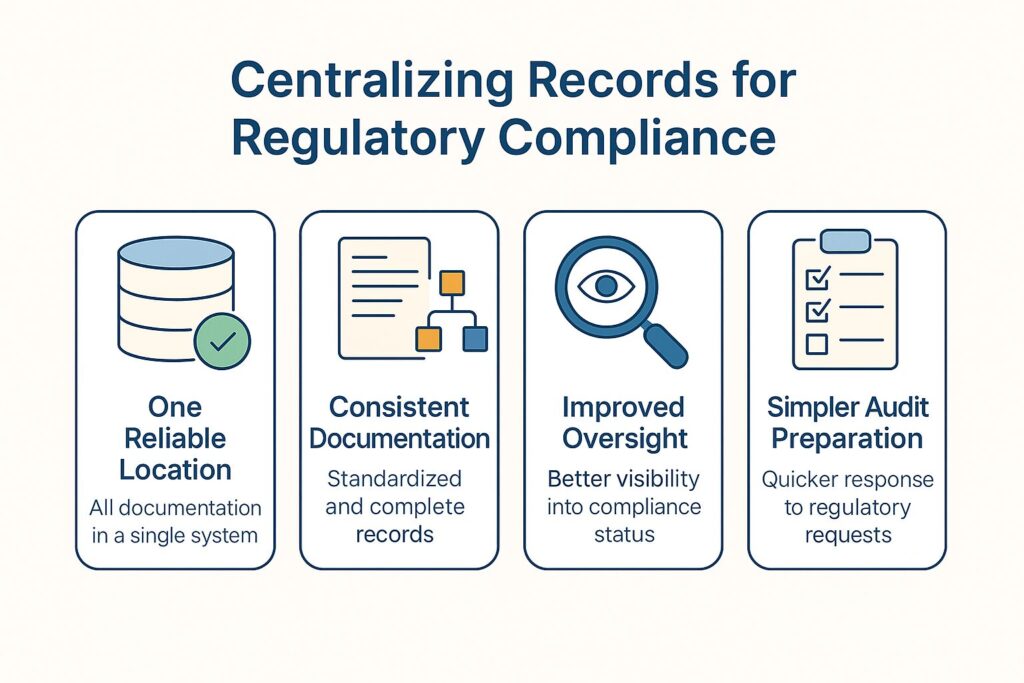
A single system for compliance documentation creates clarity across departments. Instead of searching through multiple folders or asking colleagues for copies, teams can view the entire compliance landscape in one place. This reduces the time spent preparing for audits, answering documentation requests, or piecing together partial information.
Centralization also improves the quality of the records themselves. Required fields ensure completeness. Standardized formats reduce ambiguity. Automatic date stamps provide traceability. And because the system organizes everything consistently, it becomes easier to identify gaps or upcoming deadlines before they become problems.
How FileMaker supports structured compliance management
A FileMaker-based compliance system can be tailored to your exact regulatory environment. You can define the categories, retention requirements, workflows, and approval steps that match the standards you need to maintain. Instead of bending your process to fit a generic tool, the system is structured around how your organization actually operates.
A well-designed compliance system in FileMaker can support:
- Centralized storage for all regulatory documents
- Required fields to prevent incomplete submissions
- Audit-ready timestamps and version control
- Category-based organization (training, safety, inspections, certifications, etc.)
- Automated reminders for renewals or expiring documentation
- Photo and attachment support for inspections
- Role-based security to protect sensitive information
- Approval paths and corrective-action workflows
- Historical record keeping for multi-year compliance cycles
This structure replaces scattered documents with a dependable, comprehensive system that prepares your organization for both daily oversight and formal audits.
What improves when records are centralized
Organizations that move to a unified compliance system often experience immediate benefits:
- Faster audit preparation and fewer last-minute scrambles
- More consistent documentation across teams
- Clear visibility into which requirements are current or overdue
- Less dependency on individual staff members’ filing methods
- Stronger accountability and traceability
- Easier onboarding for new personnel handling compliance
- Reduced risk of missing required updates or renewals
Instead of fighting the complexity of scattered records, your team works from a system that organizes the process for them.
If you want to simplify regulatory compliance
Portage Bay Solutions can help you design a FileMaker-based compliance solution that centralizes documentation, reduces manual effort, and keeps your organization prepared for audits. If you’d like to explore what a streamlined compliance system could look like for your team, contact us to schedule a free consultation.